
The Arctic 10+ Changed What an Immersion Suit Can Be. Duty of Care Is Why That Should Matter to You.
Updated: Sep 8
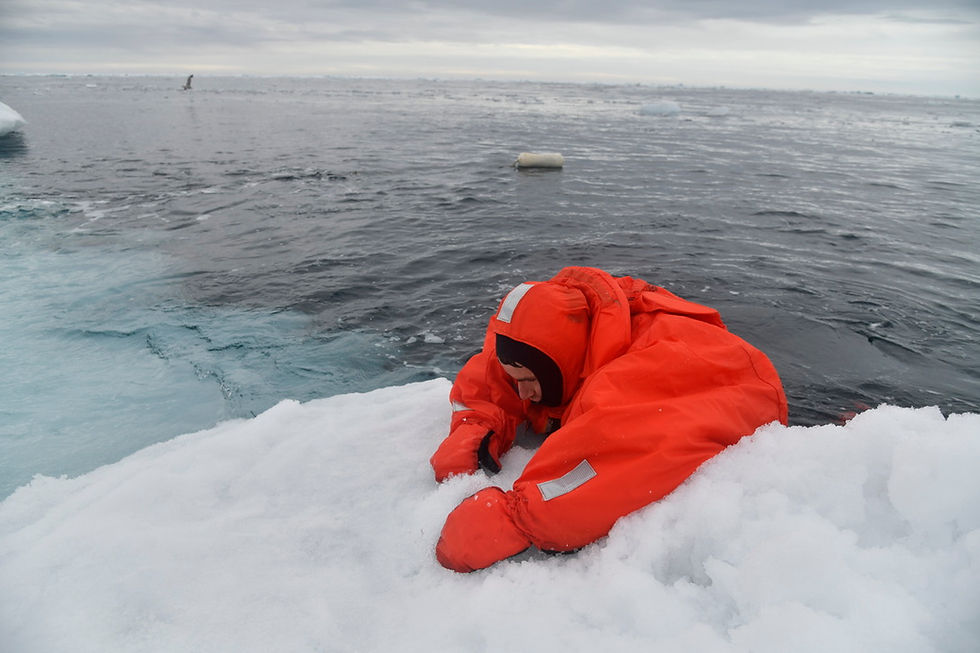
Every immersion suit on the market is judged against the same question: does it meet the applicable standard? That's the wrong starting question, and it always has been.
The right one is simpler and harder to hide from: if the person wearing this suit actually ends up in the water, or on the ice, does it keep them alive and functional long enough to be found? The Arctic 10+ was built around that second question. Most of the industry is still answering the first one.
That's not a marginal improvement in thermal rating. It's a different category of equipment, and it's why the case for adopting it shouldn't rest on whether a particular vessel, aircraft, or operation happens to fall inside a specific regulatory line. It should rest on duty of care — on whether the people responsible for a crew, a passenger list, or an aircrew actually want the best available protection for the people in their charge, regardless of which chapter number technically applies to them this year.
What actually changed
A standard immersion suit is built to do one thing: keep a person afloat and marginally insulated long enough to be pulled out of the water, on the assumption that rescue is close behind. The Arctic 10+ is built on a different assumption entirely — that a real abandonment in polar or sub-polar conditions is a multi-day problem, and that the suit has to function as short-term shelter, not just short-term flotation. Four design choices are what actually make that true, not just a higher number on a spec sheet.
It performs in extreme cold, not just the standard test benchmark. Most immersion suit certification testing happens at a single benchmark: 2°C water, roughly 10°C air, no added wind. Real polar exposure is often harsher than that. In independent Ergopro testing, the Arctic 10+ — worn with its thermal booties, available as an accessory — completed a full six-hour immersion in 0°C water, –20°C air, and a 10 m/s wind, a –30°C wind chill, with a core-temperature drop of only 0.5°C and no skin temperature ever approaching the standard's safety cutoff. That's the gap between a suit that passes its certification test and one that's been proven against conditions closer to a real Arctic abandonment.
It converts into shelter, not just flotation. A transparent, wind- and spray-proof splash tent deploys over the wearer's upper body, creating a sheltered microclimate against wind and spray — effectively turning the suit into a personal life raft and thermal shelter rather than leaving the wearer exposed to the elements while they wait.
It lets a person function, not just endure. The wearer can withdraw their arms inside the suit to conserve heat, or extend them out when a task requires it, without breaking the suit's seal. That's what makes it possible to eat, drink, signal for rescue, or perform first aid from inside the suit — the difference between passively surviving and staying capable of helping yourself.
It starts from a higher baseline. An industry-leading CLO value of 4.87, independently measured under EN 13537 static manikin testing, gives the suit meaningfully more insulation to work with before any of the above even comes into play.
Put together, those four things are why we describe the Arctic 10+ as a personal habitat rather than an immersion suit that happens to test well. A suit that extends survival time a little is still solving the same problem as a standard suit, just doing it somewhat better. A suit that lets a person function — eat, rest, signal, wait — for days, and keeps doing so even after it gets wet, is solving a different problem. That's the paradigm shift, and it's the part of the story that a compliance checklist can't capture.
Why compliance status is the wrong gate to wait behind
If the case for adoption depended on regulatory status alone, it would be a genuinely confusing case to make right now, because that status is inconsistent in ways that have nothing to do with actual risk. IMO Polar Code Chapter 8 — the chapter that sets a five-day functional survivability goal for life-saving appliances — has applied to existing SOLAS-classed vessels since 2018. But a large population of vessels operating in the same ice, the same water, facing the same rescue timelines, were never covered by it at all: fishing vessels, private yachts, and smaller cargo ships fall outside SOLAS by definition, and the Polar Code's 2026 amendments — which bring three categories of these non-SOLAS vessels into scope for the first time by January 1, 2027 — extend only navigation and voyage-planning requirements to them, not survivability. Aircrew flying over the same cold water and ice face a parallel gap: standard flight equipment was never built or tested against a multi-day survival standard at all, on any aircraft, under any chapter.
None of that is a criticism of any single regulator. It's a description of how international rulemaking actually works — incrementally, vessel class by vessel class, chapter by chapter, often taking a decade or more to extend coverage that seems obvious in hindsight. But it means "are we compliant" is not a reliable proxy for "are our people adequately protected," and it never fully will be, because the rulebook will always be catching up to where the actual exposure is. A fleet operator, a flag administration, or a program manager who waits for full regulatory coverage before upgrading equipment is deferring to a timeline that has nothing to do with the physics their crews actually face.
The case that doesn't wait on a chapter number
This is where duty of care does the work compliance can't. It doesn't ask which chapter binds a given hull or airframe this year. It asks a narrower, more useful question: given what we know is achievable — a suit that performs wet, shelters instead of just floats, keeps a person functional, and starts from a higher insulation baseline — is it defensible to equip people with anything less, once you know the better option exists?
For a fleet operator, that argument applies to every vessel, not just the ones formally in scope, because crews get reassigned and vessels get redeployed outside their typical operating area regardless of what a certificate says. For an aircrew safety officer, it applies regardless of whether the aircraft's mission profile is a water ditching or a forced landing on ice or tundra, because hypothermia doesn't check which scenario the equipment was procured against. For anyone evaluating survival equipment on behalf of people who didn't get to choose it themselves, "the Arctic 10+ changed what's possible" is a more honest basis for a decision than "the current rule doesn't require it yet."
That's the case we'd make to anyone who genuinely cares about the survivability of the people in their charge: not that the law demands it, but that the alternative is knowingly choosing an older category of equipment once a better one exists. If your operation puts people anywhere near cold water or ice — compliant on paper or not — we're glad to share the underlying test data and discuss what an evaluation would look like. Reach out at djacobson@whiteglacier.com.


Comments