
Non-SOLAS Doesn't Mean Non-Vulnerable: What Canada's New Icebreaker Fleet Needs Beyond Minimum Compliance

On August 24, Prime Minister Carney announced an $11 billion contract for six new Polar Class 3 Program Icebreakers, to be built at Chantier Davie in Lévis, Quebec. Each will carry up to 68 crew and program personnel. The first is due in 2032, with the full fleet in service by 2038.
It's the largest investment in Canadian icebreaking capability in a generation, and it will keep Canadian Coast Guard crews working in Arctic and sub-Arctic waters for decades to come. It's also a good moment to ask a question that tends to get lost in procurement paperwork: what happens to the people on board if one of these ships has to be abandoned?
The exemption that doesn't extend to the water
CCG vessels are government ships, not SOLAS ships. That distinction matters enormously for regulatory purposes — it means the Polar Code's Chapter 8 life-saving appliance requirements, which apply to SOLAS-classed vessels operating in polar waters, don't legally bind the Coast Guard's fleet.
What that exemption does not do is change the physics of cold-water immersion. A crewmember who goes into 0°C water off a non-SOLAS icebreaker faces exactly the same survival math as a crewmember off a Polar Code-compliant expedition ship. Hypothermia doesn't check registration status. The exemption is a regulatory fact; the risk is a physical one, and the two have quietly drifted apart.
This is the core of a duty-of-care argument that's harder to wave away than a compliance argument: even where the law doesn't require a higher standard, the employer's obligation to protect the people it sends into that water doesn't disappear along with the regulatory requirement.
Wet is the condition that matters, not the spec sheet
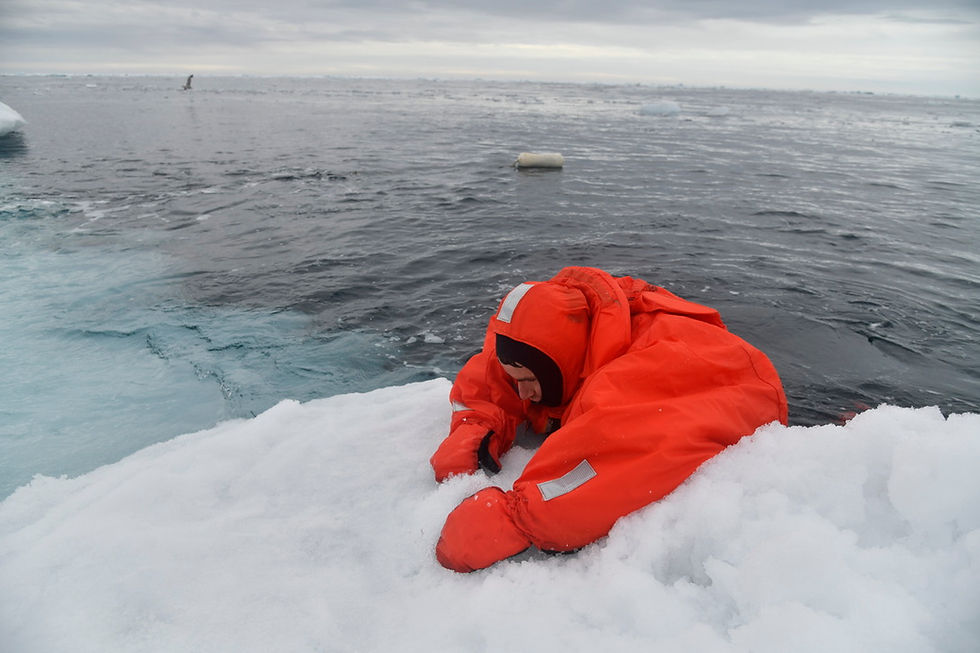
Most immersion suit thermal ratings are generated in controlled, dry testing. Real abandonment isn't dry. Suits take on water through seams, closures, and wear points during entry, in the water, and during extended exposure — and for a standard LSA suit, that water ingress isn't a minor derating. Independent testing shows standard suits lose roughly 40-45% of their thermal protection once wet.
That's the gap between a suit that passed its certification test and a suit that performs when someone actually needs it. It's also precisely the scenario a CCG icebreaker crew would face in a real abandonment in Arctic conditions: cold water, wind, waves, and time — not a calm test tank.
The Arctic 10+ was designed around that reality rather than around the test that gets a certificate issued. Its thermal performance doesn't collapse when water gets in, because the suit was built on the assumption that it will.

This isn't a 2032 problem
It's tempting to file this under "something to think about before the new fleet arrives." It isn't. The current CCG fleet is out on the ice right now — nine icebreakers are working the 2026 Arctic season, from the Louis S. St-Laurent, which reached the North Pole on a continental shelf mapping mission on August 16, to vessels supporting High and Low Arctic icebreaking through late November. Every one of those ships carries a crew whose survival equipment reflects the same non-SOLAS exemption discussed above.
The new-build program is a chance to set a higher baseline going forward. But the crews facing that exposure today shouldn't have to wait twelve years for it.
What "beyond minimum compliance" actually means in a procurement
None of this requires new regulation. It doesn't require the Polar Code to be rewritten to bind government vessels, and it doesn't require anyone to wait on an IMO process. It requires procurement decision-makers — for both the existing fleet and the new Polar Class 3 program — to evaluate survival equipment against the conditions crews will actually encounter, rather than against whichever standard happens to apply on paper.
For a fleet this size, operating in some of the most unforgiving water on the planet, "exempt" is a regulatory classification. It was never meant to be a safety target.


Comments