
The Aviation Gap: Why Arctic Flights Need More Than a Standard Flight Suit
On a long transatlantic ferry flight in April 2026, a Marine Aviation Logistics Squadron out of Belle Chasse, Louisiana equipped its aircrew with Arctic 10+ immersion suits before departure. Three suits, one flight, one very old question: if something goes wrong over the North Atlantic, how long do you actually have?
That question isn't limited to open water. A growing share of Arctic flying — polar resupply runs, research-support flights, sovereignty patrols, trans-polar cargo routes — crosses ice cap and tundra rather than ocean. A forced landing there raises the identical survival question without a single drop of water involved.
A ditching is a ditching, whatever's above the water
Cold-water immersion doesn't check whether you arrived by hull or by airframe. A crewmember who ditches in the Denmark Strait, the Bering Sea, or the North Atlantic faces the identical physiology as a mariner who abandons ship in the same water: rapid heat loss, a narrowing window before hypothermia sets in, and a rescue response that, over remote ocean, can run to hours rather than minutes. The maritime world has spent the better part of a decade building goal-based survivability standards around exactly that math. Long-range aviation routinely crosses the same water without an equivalent framework.
Or it's not a ditching at all
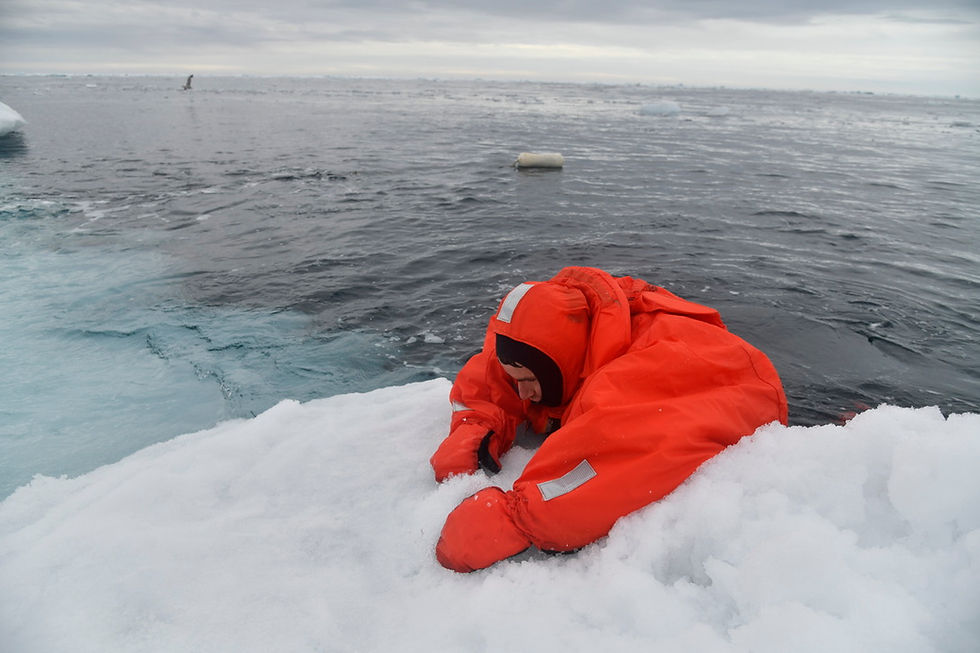
Land on the ice cap instead of the water and the equation barely changes. Wind chill and ambient cold do to an unprotected crewmember on the tundra what immersion does in the water, just on a slightly longer clock — and rescue over the high Arctic's interior can take longer to arrive than rescue over Arctic coastal waters, not less. A survival suit built only around water entry misses half of what an Arctic flight actually risks; one built around a wide operating temperature range, not just a water rating, covers both outcomes with the same gear.
What flight suits are built for isn't what either scenario demands
Standard aviation anti-exposure gear is designed first for the job aircrew do in the air — freedom of movement, compatibility with harnesses and controls, weight. Sustained cold exposure after a ditching or a forced landing, for however long search and rescue takes to arrive over open ocean or open ice, is a secondary design consideration at best, and in a lot of cockpits it isn't addressed by dedicated gear at all. That's a reasonable trade-off when the operating assumption is that either event is a rare, near-shore or near-base contingency. It's a much harder trade-off to defend on a transatlantic ferry leg, an Arctic resupply run, or a long-range patrol track that spends hours over terrain further from rescue than most routes ever get.
The services are already noticing
Nobody had to mandate the Belle Chasse squadron's decision — a unit facing a specific transatlantic leg looked at what was in its inventory versus what the flight actually exposed its crew to, and equipped accordingly. It's the second time a USMC unit has made that call; Camp Lejeune-based aircrew support did the same in 2023. The Army's Aviation Future Capability Directorate at Fort Rucker has an Arctic 10+ submission of its own working through the Soldier Enhancement Program process now, headed for review this fall. None of this amounts to a service-wide standard yet — it's still case-by-case, unit-by-unit judgment. But it's the same pattern the maritime industry went through before Polar Code Chapter 8 formalized what individual operators were already concluding on their own.
The same standard, applied where it's missing
None of this requires inventing new physics or a new certification regime. The functional-survivability logic that already governs maritime polar operations — protection that holds up wet or dry, dynamic, and over an extended rescue window, not just in a lab test — applies with equal force the moment a crew goes down in the water a ship would sail, or on the ice a ship would break through. Aviation doesn't need a Polar Code of its own so much as it needs to stop treating cold-exposure risk as an ocean-only problem when the Arctic doesn't limit itself to open water.
For crews who do end up equipped for it, the baseline is already set: CLO 4.87 thermal insulation, a water operating range of -2°C to +20°C and an air operating range of -45°C to +20°C, and design features like the batwing arm tunnel that let a downed crewmember work a radio or first aid kit without breaking the suit's seal — one suit built for waiting on rescue, whether that wait happens in the water or on the ice.


Comments