
Hours from Help: Cold-Water Survival in the Bering Sea
Rescue in Alaska is measured in hours, not minutes
In Alaskan waters, the question is not whether help will come, but how long the crew must survive until it arrives. The U.S. Coast Guard's Arctic District is responsible for more than 3.8 million square miles of ocean and over 47,300 miles of shoreline across Alaska and the Arctic.
Air Station Kodiak, the largest Coast Guard command in the Pacific, covers an area of more than 4 million square miles, including the Gulf of Alaska, Bristol Bay, the Bering Sea, and the Arctic Ocean. Kodiak itself sits roughly 250 miles southwest of Anchorage, and much of the Bering Sea fishing grounds lie far beyond that.

The Coast Guard crews who fly these missions are among the most capable in the world. But no crew can shorten the distance, and no aircraft can fly through every storm. For a fishing, towing, or cargo crew abandoning ship in the Bering Sea, the time between entering the water and being recovered can easily stretch into many hours.
What a standard immersion suit is designed to do
A standard SOLAS insulated immersion suit is approved against a defined laboratory benchmark. Under the IMO test requirements (MSC.81(70)), the wearer's core temperature must not fall by more than 2°C after six hours in calm, circulating water between 0°C and 2°C.
That benchmark is valuable, but it is narrow. It assumes calm water, a dry wearer who donned the suit correctly before entering the water, and a six-hour window. It does not account for wind, breaking seas, spray, darkness, or a crew member who was already wet when the order to abandon ship came.
Standard LSA suits were never designed nor tested for these conditions. In the Bering Sea in winter, those conditions are not the exception. They are the operating environment.
When rescue takes longer than the suit was designed for
The survival gap opens when the expected time to rescue exceeds what the suit was built to deliver. A six-hour laboratory benchmark offers little assurance when weather grounds aircraft, when the nearest asset is engaged on another case, or when a vessel goes down far from any forward base.
The risks in that gap compound one another:
Water ingress. A crew member who enters the water before fully sealing the suit loses insulation rapidly, and most suits offer no way to recover from it.
Loss of dexterity. Once hands are cold, survivors cannot operate zippers, signal devices, or radios, and cannot help one another.
Exposure above the waterline. Wind and spray strip heat from the head and face, which the calm-water test never measures.
No means to sustain the body. After several hours, survival depends on hydration, energy, and warmth that a standard suit makes no provision for.
For Alaska operators, this is not a theoretical concern. It is the scenario that should define how survival equipment is chosen.
What the Arctic 10+ changes
The Arctic 10+ was designed for the hours after the laboratory benchmark ends. It is an abandon-ship immersion suit approved by the U.S. Coast Guard, Transport Canada, the EU (MED), and the UK MCA, and it addresses each of the risks above.
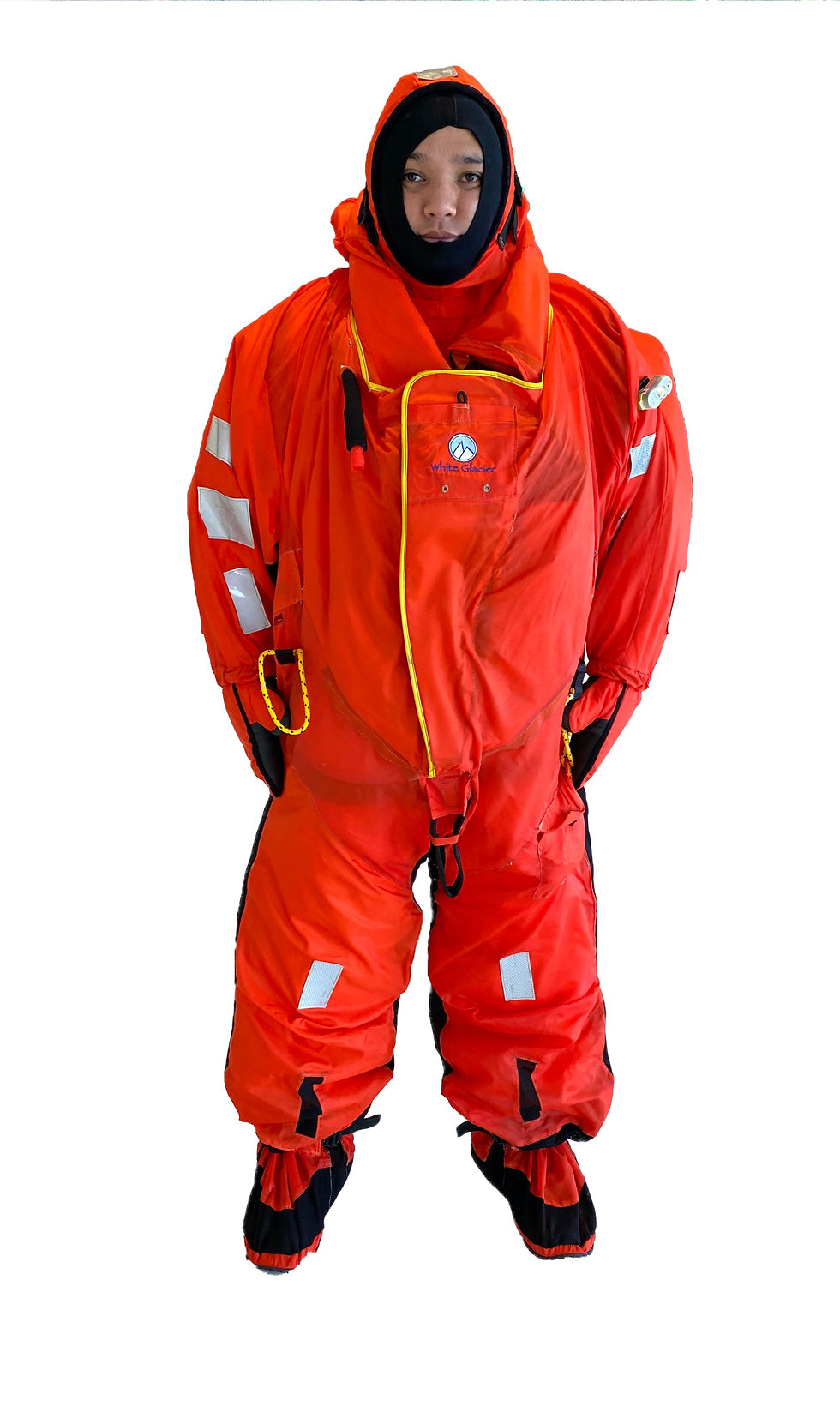
Thermal margin. In independent testing at Ergopro (Trondheim, Norway, 2022) under the standard MSC.81(70) protocol, the Arctic 10+ wearer's core temperature fell by 0.9°C over six hours in 2°C water, less than half the 2°C the standard allows. The suit's static manikin insulation rating is 4.87 clo.
Wet donning. The Arctic 10+ is designed to be donned in the water, so a crew member swept overboard or forced to enter the water early is not left without protection.
Hand access. Survivors withdraw their hands inside the suit, use an interior zipper pull to open the zipper, and have their hands free to eat, drink, signal, administer first aid, or assist a crewmate.
Integrated splash tent. The splash tent shields the face and upper body from wind, rain, and spray while survivors eat, drink, or treat injuries.
A survival protocol, not a countdown. Combined with a defined protocol of hand warmers, water, and food, extreme cold-water testing at Ergopro indicates the Arctic 10+ can support survival for five or more days, depending on the supplies available. Further validation is underway in Canada and Norway.

The result is a different kind of emergency. Instead of a race against hypothermia, the crew faces a survival situation they can manage until help arrives.
Questions every Alaska operator should ask
Before the next season, owners, captains, and safety managers should be able to answer five questions about the suits aboard their vessels:
How long would it realistically take to recover my crew from the water where we fish or operate, in the worst weather we sail in?
Does my immersion suit's tested performance exceed that rescue time, or only the six-hour laboratory benchmark?
Can my crew still be protected if they enter the water before the suit is fully donned?
Once in the water, can they use their hands to signal, drink, eat, and help one another?
If I had to explain my choice of survival equipment after a casualty, would that choice hold up?
If any answer is uncertain, the equipment decision deserves a second look.
Equip for the rescue you will actually face
The Bering Sea does not grade on a laboratory curve. The crews who work these waters deserve survival equipment chosen for the real rescue times and real conditions they face, not for the minimum a standard requires.
White Glacier Manufacturing designs and builds the Arctic 10+ for exactly those conditions. Operators who would like to discuss their fleet's requirements, arrange a demonstration, or request technical documentation are welcome to contact Diego Jacobson, CEO, at djacobson@whiteglacier.com.
#BeringSea #Alaska #CommercialFishing #Towing #TugLife #MaritimeSafety #ImmersionSuit #SearchAndRescue #DutyOfCare #ColdWaterSurvival #Arctic10
Sources
Ergopro test report 03-2022 (Arctic 10+, MSC.81(70) protocol) and report 20636-008 (static manikin); available on request


Comments