
From Countdown to Survival: How the Arctic 10+ Redefines a Cold-Water Emergency
Introduction
For as long as immersion suits have existed, the word "emergency" has carried an unspoken assumption: that it is a race against time. When a crew member enters cold water, the clock starts. Every decision that follows — how quickly a vessel can turn, whether a helicopter can launch, whether a rescue boat can be put in the water — is measured against how long the human body can hold out before hypothermia takes over.
That assumption has shaped not only survival equipment, but also the way operators plan voyages, the way search and rescue is coordinated, and the way crews themselves think about the worst day at sea. The Arctic 10+ was designed to challenge that assumption directly. It does not simply extend the countdown; it changes what an emergency can be.

The Old Paradigm: An Emergency Measured in Hours
The international standard for insulated immersion suits is built around a six-hour test: a wearer in calm, circulating water between 0°C and 2°C must not lose more than 2°C of core body temperature over that period. This benchmark has served the industry for decades, and it reflects a reasonable assumption for many trading routes — that rescue resources are close enough to arrive within a matter of hours.
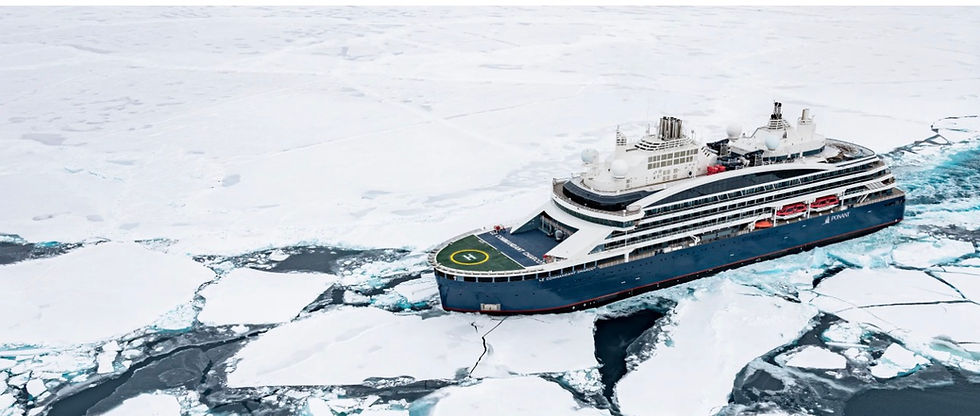
The difficulty is that the assumption no longer holds for a growing share of maritime operations. Polar expedition cruising, Arctic fishing, research voyages, and remote cold-water transits routinely take vessels far beyond the reach of rapid rescue. In these waters, search and rescue assets may be many hours or even days away, and weather can prevent them from operating even when they are close.

In ice-covered waters, rescue assets may be many hours or days away. (U.S. Coast Guard photo)
It is important to state this plainly: standard LSA suits were never designed nor tested in polar conditions. They were designed for a world in which an emergency is short. When rescue takes longer than the suit was built to last, the equipment itself becomes the limiting factor in whether a person survives.
The Shift: From a Countdown to a Managed Survival Situation
The Arctic 10+ was engineered to protect a person not for hours, but for days. Extreme cold-water testing at Ergopro indicates that, when used with a simple survival protocol — hand warmers, drinking water, food sachets and energy bars — the suit can support survival for five days or more, depending on the supplies available. Validation of this protocol is now underway in Canada and Norway.
This changes the nature of an emergency at its foundation. When the suit is no longer the limiting factor, hypothermia ceases to be the clock that governs every decision. The constraint moves to where it belongs: the logistics of locating and recovering the survivor.
The practical consequences are significant:
Search and rescue gains time to coordinate. Assets can be tasked, positioned and deployed properly rather than rushed into action.
Rescuers face less pressure to take unsafe risks. A crew that knows the survivors can endure is not forced to launch in conditions that endanger the rescuers themselves.
Voyage planning can be honest about rescue times. Operators can plan around the realistic time to rescue in remote waters, rather than around a six-hour window that may bear no relation to their route.
In short, an emergency stops being a countdown and becomes a survival situation that can be managed.
Wet Donning: Protection That Works the Way Emergencies Actually Happen
Certification tests are conducted under controlled conditions: a dry test subject, a calm environment, and time to don the suit correctly. Real emergencies rarely offer any of these. Crew members are often already soaked by spray, rain, green water on deck, or a partial immersion before they ever reach their suit. Hands are cold, the vessel may be heeling, and every second counts.
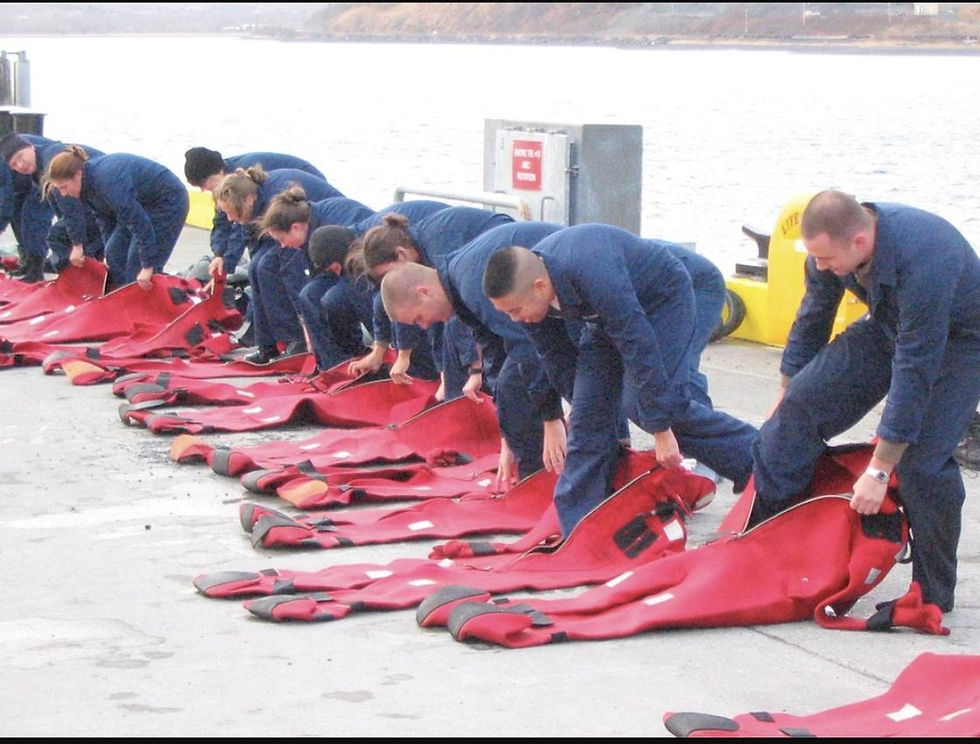
Donning drills are conducted in controlled conditions. Real emergencies rarely are.
A suit that loses much of its protection when donned over wet clothing offers far less in practice than its certificate suggests. The Arctic 10+ is designed to remain effective when donned wet. This is not a secondary feature; it is what ensures that the extended survival time described above is actually available to the person who needs it, in the conditions under which they will need it.
If extended thermal protection creates the time, wet donning ensures that the time is there when the emergency is real.
Hand Access and the Splash Tent: An Active Participant in One's Own Survival
Surviving for days is not the same as surviving for hours. Over an extended period, a person must be able to eat, drink, activate hand warmers, and administer first aid — to themselves or to others in the water with them. Conventional immersion suits with fixed gloves make this impossible. The wearer is reduced to waiting passively, unable to act even when food, water or medical supplies are within reach.
The Arctic 10+ was designed to solve this problem. The wearer can withdraw their hands from the sleeves into the interior of the suit, reach the interior zipper pull, open the zipper, and regain free use of their hands. With their hands available, the survivor can open food sachets and water, use hand warmers, and treat injuries.

Splash tent open: with a hand free, the wearer can eat and drink while afloat.
The integrated splash tent completes this capability. Deployed over the head and upper body, it protects the wearer from wind, rain and splash, allowing them to eat and drink while sheltered from the elements rather than exposed to them. In the conditions typical of cold-water emergencies — spray, precipitation and wind chill — this protection is what makes sustained survival practical rather than theoretical.

Splash tent closed: the wearer is sheltered from wind, rain and splash.
Together, these features change the survivor's role. Instead of enduring the emergency passively, the wearer remains an active participant in their own survival: able to maintain hydration and energy, conserve warmth, and help those around them until rescue arrives.
What This Means for Operators and Regulators
The regulatory framework for polar waters already recognises that rescue can take a long time. Chapter 8 of the IMO Polar Code is goal-based: it requires that personal survival equipment provide adequate protection for the maximum expected time of rescue, which may never be taken as less than five days. Standard LSA suits, designed and tested around a six-hour benchmark in calm water, do not meet the goal-based requirements of Polar Code Chapter 8.
The same logic extends well beyond polar waters. Wherever extended search and
rescue is possible — remote fishing grounds, offshore operations, research voyages and other cold-water routes — an operator's duty of care is measured against the time it may actually take to reach a person in the water, not against the duration of a certification test.
For operators, the questions are straightforward:
What is the realistic time to rescue on each route we operate?
Does our survival equipment protect our crew and passengers for that entire period?
Can our people don their suits when already wet, and can they eat, drink and give first aid while waiting for rescue?
If the honest answer to any of these questions is uncertain, the emergency plan rests on an assumption rather than on evidence.
Conclusion: Redefining the Emergency
The Arctic 10+ changes the paradigm through three capabilities that work together. Extended thermal protection creates the time. Wet donning ensures that time is available in a real incident, not only in a test tank. Hand access and the splash tent ensure that the time can be used — to eat, drink, stay warm and care for others.

The result is a new definition of what an emergency can be: not a race against hypothermia that rescuers are too often destined to lose, but a period of survival that can be managed until help arrives.
We invite vessel operators, safety managers, flag administrations and search and rescue professionals to review their emergency plans against the realistic time to rescue in the waters where they operate. White Glacier Manufacturing would welcome the opportunity to share our supporting evidence and discuss how the Arctic 10+ can close the gap between the survival time equipment provides and the survival time an emergency may demand.
Contact: djacobson@whiteglacier.com


Comments