
Does Your Immersion Suit Outlast Your Rescue Plan?

In the early hours of 15 February 1982, the drilling rig Ocean Ranger capsized on the Grand Banks of Newfoundland. All 84 people aboard were lost.
The crew abandoned the rig in a winter storm; at least one lifeboat was launched, and men ended up in the sea. The first helicopter arrived about an hour after the final radio message. By then, most of the crew had already succumbed to hypothermia or drowned in water barely above freezing.
The Royal Commission that investigated the disaster reached a conclusion that still applies to every offshore installation today: once abandonment became necessary, it was of paramount importance that the crew be able to survive until help arrived. The crew did not die because they failed to escape. They died because nothing kept them alive long enough to be rescued.
Forty-four years later, every offshore regime requires immersion suits. The question the Ocean Ranger raised has not gone away. It has simply moved from whether suits are carried to whether they last long enough.
The question in every emergency plan
Every offshore installation has an emergency response plan, and every plan contains an assumption, stated or not, about how long a person may spend in the water before being recovered.
That assumption depends on where the installation is and when the emergency happens. In the North Sea, a standby vessel may be close by. On the North Slope, in the Beaufort or Barents Sea, or on the Grand Banks in winter, rescue may be hours away: darkness, weather and distance all stretch the timeline.
Whatever the assumed rescue time is, the immersion suit is the barrier that has to hold for all of it. That leads to a simple question, and one that is rarely asked out loud:
Does the thermal endurance of your immersion suits exceed the rescue time your own emergency plan assumes, in the conditions where your people actually work?
Why an approval certificate does not answer it
Most offshore installations and support vessels carry immersion suits approved to the SOLAS Life-Saving Appliances standard. That approval is valuable, but it answers a narrower question than the one above.
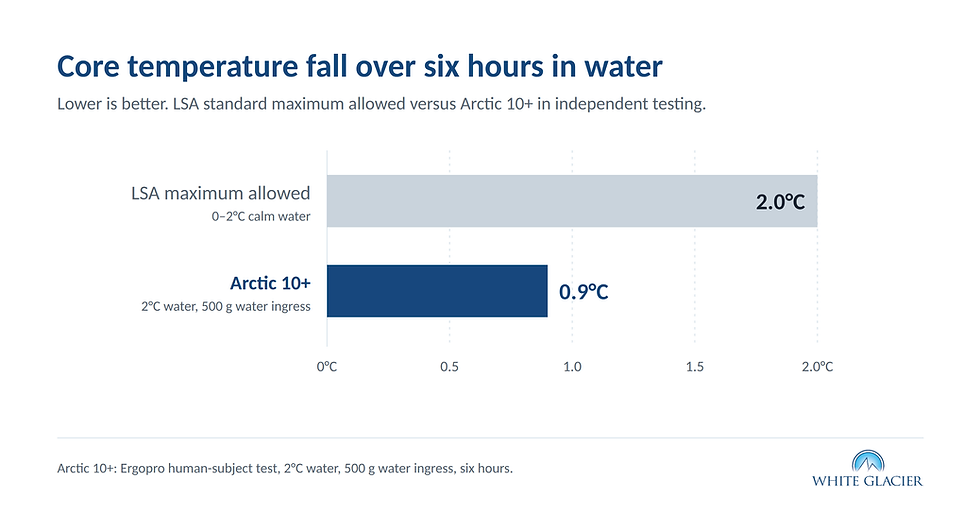
The standard's thermal test measures a suit in calm, circulating water of 0–2°C, and allows the wearer's core temperature to fall by up to 2°C over six hours. The test includes no sub-zero air, no sustained wind, no waves and no ice. Standard LSA suits were never designed nor tested for polar conditions, and they do not meet the goal-based requirements of Polar Code Chapter 8.
Offshore safety law in the major cold-water jurisdictions is goal-based. In the UK and Norway, the duty holder must reduce risk to personnel as low as reasonably practicable and plan for their recovery after evacuation. Holding approved equipment does not by itself discharge that duty. In practice, three things widen the gap between the test tank and the sea:
Air and wind. Wind chill on the head, face and hands drives heat loss the tank test never measures.
Water ingress. Water entering during a jump or a rushed donning degrades insulation, often badly.
Fit. A poorly fitting suit, especially on a larger worker, leaks and compresses its insulation.
What better protection looks like
The Arctic 10+ was designed for the conditions the approval test leaves out.
In independent human-subject testing at Ergopro, a test subject wearing the Arctic 10+ spent six hours in 2°C water with 500 g of water deliberately introduced into the suit. Core temperature fell by 0.9°C, less than half of the 2°C the LSA standard allows.

The suit is built to hold its performance when things go wrong: it tolerates wet donning, so a worker who enters it already wet, or takes on water during abandonment, keeps their protection. Used with a defined survival protocol (hand warmers, water and food sachets), it is designed to support survival for five days or more, depending on the supplies available. Field validation of that protocol is under way in Canada and Norway.

Four questions worth asking
None of this requires a new regulation. It requires a comparison most duty holders can make with documents they already have:
What rescue time does our emergency plan assume for personnel in the water, in the worst credible weather and season?
What thermal endurance do our current suits have, and under what test conditions was it demonstrated?
Do those test conditions resemble our location in winter, or only a calm laboratory tank?
If the endurance is shorter than the assumed rescue time, or has never been compared with it, what have we done to close the gap?
The same questions apply to drilling contractors and marine service providers, who carry their own duty of care for their people.
The Ocean Ranger inquiry measured survival equipment against one standard: the time needed for help to arrive. That is still the right test.
Our white paper, Beyond Approval: Duty of Care and Cold-Water Survival in Offshore Oil & Gas, sets out the regulatory framework and the rescue-time comparison in detail. To request a copy, or to arrange a private Learn to Return in-water demonstration for your emergency response team, contact Diego Jacobson at djacobson@whiteglacier.com.
#immersionsuits #dutyofcare #emergencyresponse #coldwatersurvival #ALARP #arctic10plus #whiteglacier


Comments