
Advancing Life-Saving Appliance Standards: Insights from SSE 12
Updated: Apr 7
The International Maritime Organization’s Sub-Committee on Ship Systems and Equipment (SSE) plays a vital role in shaping the safety standards that govern vessels worldwide. From 10 to 14 March 2026, SSE 12 convened in London to review technical proposals on life-saving appliances (LSA), fire safety, and other ship systems. Bureau Veritas has published a clear summary of the meeting’s key outcomes. While the session advanced several important LSA items, it also underscores a continuing priority for polar operators: ensuring survival equipment truly performs in the harsh conditions the Polar Code was written to address.
Key Discussions at SSE 12
The meeting made steady progress on a range of LSA-related matters, including:
Amendments to the LSA Code concerning partially enclosed lifeboats
Revisions to SOLAS Chapter III and the LSA Code
Incorporation of self-righting or canopied reversible liferafts
These updates reflect the IMO’s ongoing work to improve the reliability and usability of life-saving equipment across all vessel types. However, the summary report does not indicate new prescriptive requirements for thermal performance of immersion suits or specific amendments to Polar Code Chapter 8 during this session.
Importance for Polar Operators
The Polar Code remains a goal-based framework. Chapter 8 still requires “adequate thermal protection” and “sufficient thermal insulation” to support survival for the Maximum Expected Time of Rescue (METR) — never less than five days in remote polar waters. That requirement has not changed.

In practice, METR in the Arctic and Antarctic frequently exceeds five days due to ice, vast distances, weather, and limited SAR assets. The 2023 USCG Arctic SAR Simulation Study and independent Ergopro 2022 testing continue to show that standard SOLAS/LSA immersion suits (typically neoprene) lose functional survivability within 6–12 hours under realistic polar conditions (sub-zero air, wind chill, and water ingress).
This is the exact gap the Polar Code was designed to close — and why operators who take compliance seriously are looking beyond minimum standards.

The Arctic 10+ Advantage in Meeting Polar Code Intent
White Glacier’s Arctic 10+ immersion suit was engineered precisely for the conditions the Polar Code describes but standard suits were never tested for:
Industry-leading CLO value of 4.87 (versus typical 2.0–2.5 for neoprene suits)
Patented splash tent that creates a personal habitat, blocking wind and spray
Removable-arm system allowing internal access for eating, drinking, and rest
Proven performance in independent testing: <0.5 °C core temperature drop over 6+ hours in –20 °C air, 0 °C water, and 10 m/s wind

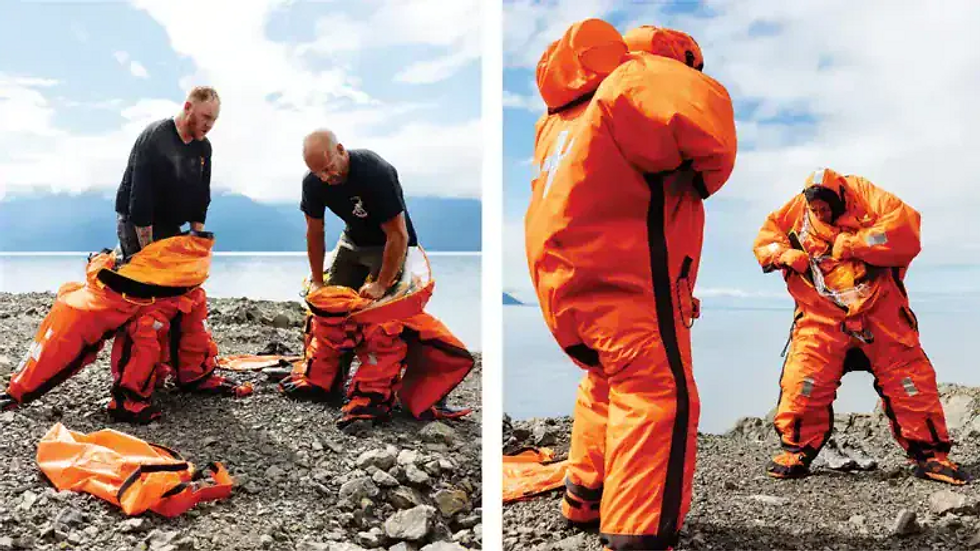
These features enable crews to remain functional for multiple days — not just survive — directly supporting the goal-based intent of the Polar Code.
Future Considerations for Polar Operations
SSE 12’s focus on broader LSA improvements is positive, but the fundamental challenge for polar shipping remains unchanged: survival equipment must work in the actual environment and for the actual METR. As polar traffic grows and regulatory scrutiny (such as Chile’s DIRECTEMAR PSC inspections) increases, operators who choose equipment proven in real polar conditions gain a clear advantage in safety, compliance, and operational resilience.
Conclusion: The Path Forward
White Glacier continues to support flag states, Recognized Organizations, and vessel operators with technical briefings, test data, and solutions that go beyond minimum compliance to deliver genuine polar readiness.

Ready to ensure your fleet meets both the letter and the spirit of the Polar Code? Contact Diego Jacobson, CEO White Glacier djacobson@whiteglacier.com | +1 939-430-1264 www.whiteglacier.com
This post is for educational purposes and references the Bureau Veritas SSE 12 Summary Report (March 2026), the IMO Polar Code, and publicly available studies (USCG 2023, Ergopro 2022). White Glacier products are certified to USCG, MED, Transport Canada, and UK MCA standards; no regulatory endorsement is implied.


Comments