
Donning Speed vs. Survival Time: What Actually Determines Outcomes in Cold Water
In recent discussions about maritime safety, donning speed has taken center stage. New immersion suit designs emphasize faster closures, simplified components, and standardized sizing to reduce the time required to get protected during an emergency—an approach recently highlighted in gCaptain coverage of newly launched immersion suits focused on rapid deployment.
This focus is understandable. In high-stress situations, seconds matter. Panic, poor visibility, vessel motion, and crew fatigue all increase the risk of error. Any improvement that helps a mariner get into a suit correctly and quickly is a step in the right direction.
But donning speed only solves the first problem.
The question that ultimately determines outcomes in cold water emergencies is not how fast a suit goes on, but how long it keeps a person alive once they are in the water.
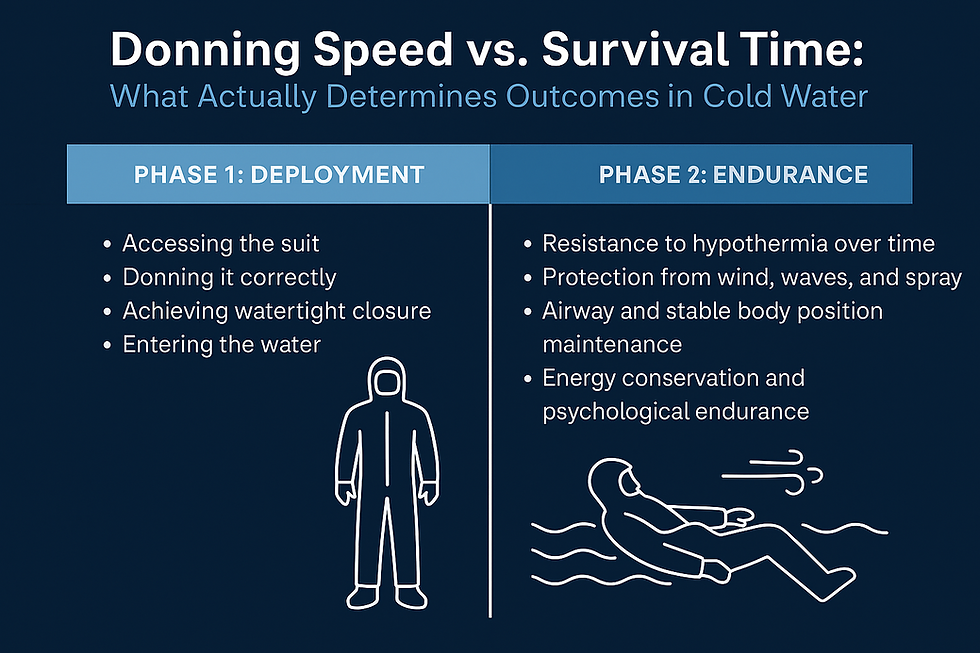
The Two Phases of Cold-Water Survival
Cold-water survival can be divided into two distinct phases:
Phase 1: Deployment
This includes:
Accessing the suit
Donning it correctly
Achieving watertight closure
Entering the water
Design choices that improve usability—zippers, glove configuration, sizing, ergonomics—matter most here. Faster, simpler systems reduce mistakes and increase the likelihood that a suit is used as intended.
Phase 2: Endurance
This phase begins after immersion and continues until rescue.
It includes:
Resistance to hypothermia over time
Protection from wind, waves, and spray
Maintenance of airway and stable body position
Energy conservation and psychological endurance
In cold and polar waters, Phase 2 is where most fatalities are determined—and where survival windows can stretch far beyond initial expectations.

Why Six Hours Is Not a Universal Answer
Many modern immersion suits are designed around a thermal protection window of approximately six hours. For operations near shore, in temperate waters, or along heavily trafficked routes, this may align with realistic rescue timelines.
But increasingly, maritime operations do not fit that profile.
Arctic and sub-Arctic shipping, expedition cruising, icebreaker operations, offshore energy, fisheries, and government patrols operate in environments where:
Air support may be unavailable or delayed
Sea state limits small craft recovery
Weather or ice prevents fast response
Rescue timelines extend well beyond six hours
In these conditions, compliance-level protection becomes a starting point—not a safety margin.

The Environmental Factors Most People Underestimate
Water temperature alone does not define cold-water survival.
Extended exposure is driven by:
Wind chill above the surface
Wave-driven spray and evaporative heat loss
Nighttime radiation and precipitation
The survivor’s ability to remain still and conserve energy
Once the initial cold shock passes, convective and evaporative heat loss often dominate. A suit that insulates but leaves the wearer continuously exposed to wind and waves may perform well in laboratory conditions—yet fail to provide meaningful endurance in real-world seas.
Donning Speed vs. Survival Systems
Focusing primarily on donning speed tends to prioritize:
Reduced bulk
Minimal components
Simplified construction
Designing for extended survival shifts priorities toward:
Trapped thermal microclimates
Integrated shelter concepts
Stable flotation and airway protection
Hands-free endurance over many hours
These design goals are not mutually exclusive—but they are not weighted equally depending on operating environment.
When rescue may take a full day rather than a few hours, the design decisions that matter most are those made after the zipper is closed.
Compliance Is Not the Same as Capability
Regulatory certification defines minimum acceptable performance. It ensures that a suit meets established benchmarks under controlled assumptions.
Operational capability addresses a different question:
What happens when conditions exceed those assumptions?
As maritime activity expands into colder and more remote regions, operators are increasingly evaluating survival equipment not just for compliance, but for outcome-based performance—how long a crew member can remain viable, functional, and alert in realistic worst-case scenarios.


Comments