
Case Studies of Polar Incidents and Lessons Learned: What the Arctic 10+ Would Have Changed
- diego7475
- Dec 16, 2025
- 2 min read
Over the past four decades, several high-profile incidents in polar and sub-polar waters have exposed the lethal gap between regulatory minimums and actual survival requirements. Three cases, in particular, illustrate why 6-hour immersion suits have repeatedly failed crews when rescue was delayed beyond a few hours.
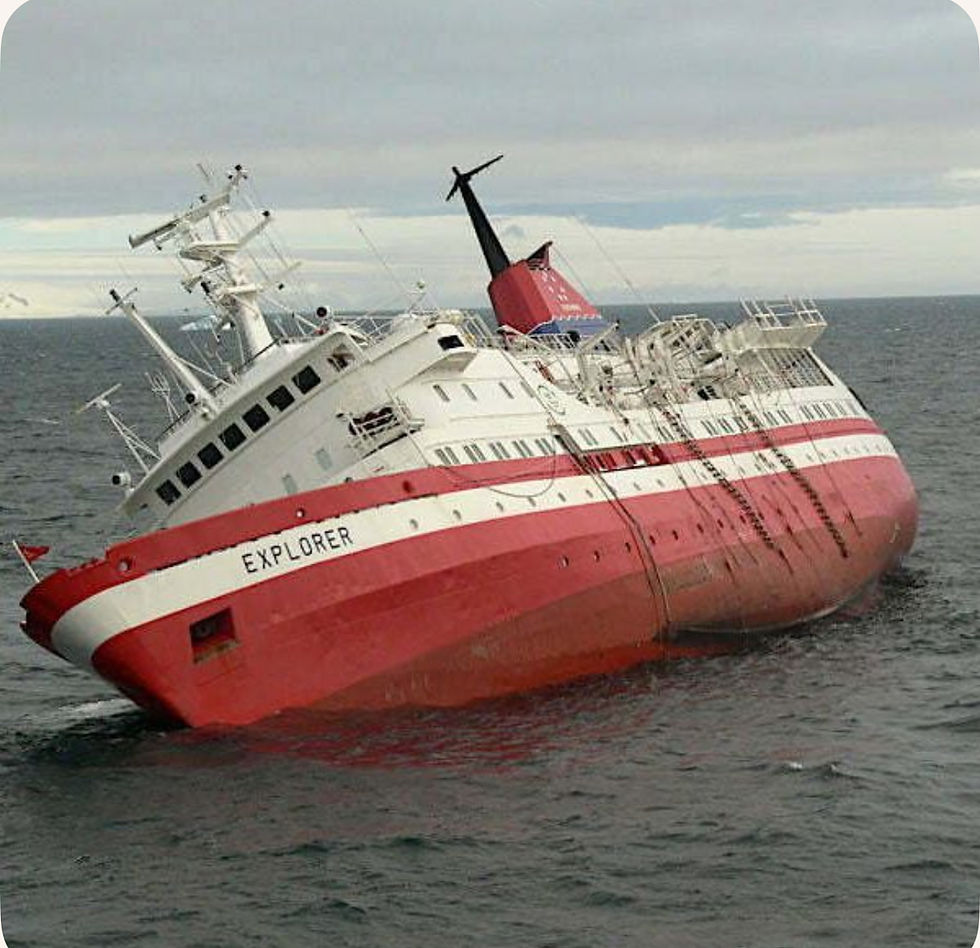
1. MV Explorer – Antarctic Peninsula, 23 November 2007 The “Little Red Ship” struck ice and sank in the Bransfield Strait. Water temperature: 1–2 °C. Air temperature: −5 °C with 30–40 knot winds. All 154 passengers and crew abandoned into lifeboats and rafts. Rescue arrived within 5 hours. Outcome: No fatalities, but many survivors in standard 6-hour suits showed early signs of hypothermia (shivering, confusion) after only 2–3 hours of exposure to wind and spray while awaiting transfer. Had rescue been delayed by weather (common in the area), the first deaths would likely have begun around the 5–6 hour mark.
2. Fishing Vessel Scandies Rose – Gulf of Alaska, 31 December 2019 The 130-ft crab boat capsized in 20-ft seas and 50+ knot winds. Water temperature: 5.5 °C. Five of the seven crew managed to don standard immersion suits. The two who reached the raft survived. The five who entered the water did not, despite wearing approved suits. Autopsies and survivor testimony confirmed that functional hypothermia set in rapidly due to wave splash and wind chill eroding the suits’ insulation. All five were lost within roughly 3–4 hours.
3. F/V Destination – Bering Sea, 11 February 2017 Similar conditions to Scandies Rose. Six crew lost. Again, all wore approved 6-hour suits. The US Coast Guard investigation noted that “even if the crew had successfully donned immersion suits, survival time in those conditions would have been limited.”
What the Arctic 10+ changes in these scenarios
CLO value > 4.87 (vs ~0.75 for standard suits) → core temperature drop slowed by 60–70 %
Patented facial seal and triple-layer neck dam → near-zero flush events, preserving insulation even in breaking waves
14+ hours of documented thermal protection in 0 °C water / 40-knot wind (independent ERGOPRO testing)
Integrated 10-day food/water/signal pack → crews remain functional while awaiting delayed rescue
In both Bering Sea losses, survivors might have reached the raft or stayed coherent long enough for helicopter hoist. In the Explorer scenario, the entire complement would have remained functional for multiple days if weather closed the area.
The hard lesson from these incidents: the Polar Code’s 6-hour minimum is a regulatory compromise, not a survival guarantee. When the helicopter is 12, 24, or 48 hours away (as it often is north of 70° or in the Southern Ocean), only systems engineered for multi-day protection turn probable fatalities into probable rescues.


Comments